﷽
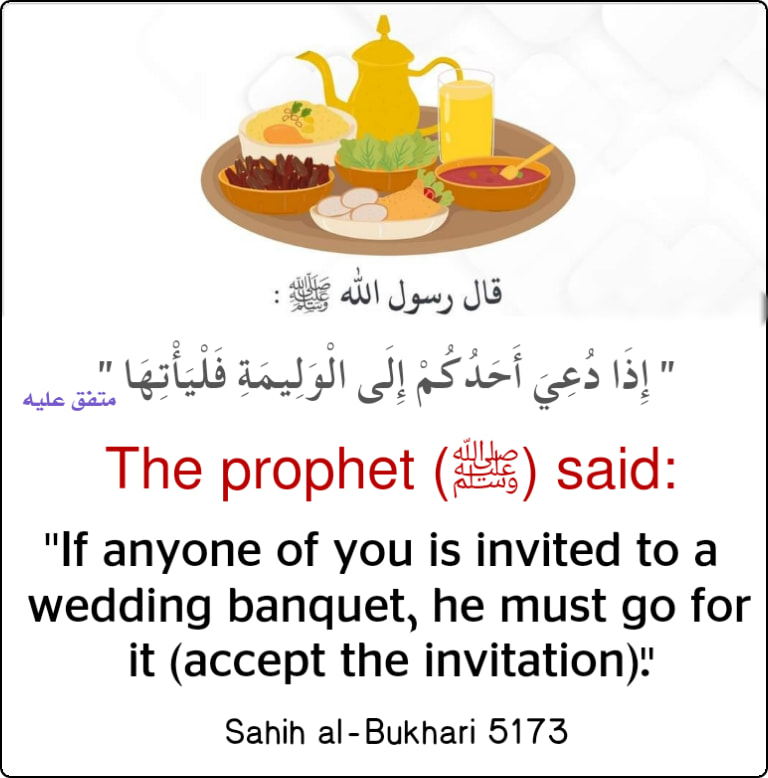
Answering the Invitation to a Wedding Feast (Walīmah) becomes obligatory (only) upon fulfillment of six conditions:
- The invitation is for the first day
- The individual who is inviting is a Muslim
- The host should not be someone whom it is obligatory or Sunnah to forsake
- The invitation is specifically for him (i.e. not a general public invitation)
- There should not be anything objectionable (at the venue) which he cannot prevent
- The host should be someone who earns from permissible means.
In further explanation of the fifth condition “There should not be anything objectionable”, the author said:
It was narrated that ʿAlī -may Allāh be pleased with him- said:
“I made some food and called the Messenger of Allāh (ﷺ) (to come and eat). He came and saw some images in the house, so he went back.”
Narrated by Ibn Mājah (3359) and Shawkānī said it’s men are the men of Ṣaḥīḥ
The ḥadīth of ʿUmar that the Prophet (ﷺ) said:
Whoever believes in Allāh and the Last Day should not sit at a table where wine is being served.
Narrated by Aḥmad and by at-Tirmidhī (from the ḥadīth of Jābir 2801) and he graded it as Ḥasan
Al-Bukhārī mentioned:
Ibn Masʿūd saw a picture in the house and returned when some of his companions had invited him.
And he (Mūsā bin Aḥmad Al-Maqdisī Al-Ḥajjāwī) said in Al-Iqnāʿ
“If the one invited knows that there is something reprehensible in the feast such as musical instruments, wine, lute, drums, and the likes or (he knows that there are) gold or silver vessels or furnishings that are prohibited, and he is able to remove the reprehensible thing, then he must attend and denounce it. Because in doing so he fulfills two duties: answering his Muslim brother and removing the reprehensible thing.
And if he is not able to (remove the reprehensible thing) he should not attend.
(And if he does not know) about the reprehensible thing (until he attends and witnesses it,) he should remove it and remain thereafter (in response to the one who invited him.
And if he is not able) to remove it (he should leave) due to what was mentioned previously.”
– Shaykh Ṣāliḥ bin Ibrāhīm al-Bulayhī, Chapter of the Wedding Feast, as-Salsabīl fī Maʿrifati ad-Dalīl Ḥāshiyah ʿAlā Zād Al-Mustaqniʿ, Pg. 735
About the author
Shaykh Ṣāliḥ bin Ibrāhīm al-Bulayhī -may Allāh have mercy on him- was
- From the students of Muḥammad bin Ibrāhīm bin ʿAbdul-Latīf
- Born in 1331 AH in the city of Al-Shamasiyah.
- In 1338 AH, the family moved to Buraidah and he studied the Qur’ān in a private school. He then worked with his father in trade and then agriculture, and then devoted himself to seeking knowledge. The Shaykh acquired knowledge from the great scholars of Buraidah, such as: Omar bin Salim, who he accompanied closely, Abdullah bin Muhammad bin Hamid, the head of the Supreme Judicial Council, Abdul Aziz Al-Abbadi, Saleh bin Ahmed Al-Khuraisi, and Muhammad bin Saleh Al-Mutawa.
- He was offered the position of judge, but he refused. He was appointed as a teacher at the Educational Institute in Buraidah in 1373 AH. In 1384 AH, he was appointed as an imam at Al-Wazzan Masjid, and he began to teach many Islamic sciences such as jurisprudence, hadith, interpretation, inheritance, and others. When the College of Shariah was established in Al-Qassim, he was asked to teach the subject of jurisprudence, and he agreed.
- He was very active in giving lectures in masjids and schools, and he also contributed to establishing the Charitable Society for Memorizing the Holy Quran. The Shaykh suffered from heart disease, then traveled to Britain for treatment, and when he returned, his condition improved, so he continued to preach and guide, then the disease worsened; he remained in his house and bed. He passed away on Friday at three o’clock, corresponding to the 3rd of Jumada al-Ula 1410 AH, and Sheikh Ṣāliḥ bin Ahmed Al-Khuraisi prayed for him in the Grand Mosque, and many scholars attended, including his student, Shaykh Muḥammad bin Ṣāliḥ bin ʿUthaymīn
About the book
In the book “as-Salsabīl fī Maʿrifati ad-Dalīl Ḥāshiyah ʿAlā Zād Al-Mustaqniʿ”, authored by Shaykh Ṣāliḥ bin Ibrāhīm al-Bulayhī (1331-1410H), he wrote comments on the book “az-Zād” mentioning the evidences for its rulings from the Qur’ān and Sunnah and differences between the Imāms with regards to it.
In the book, “Zād Al-Mustaqniʿ fī ikhtiṣār al-Muqni’”, the author, Abū an-Najah Mūsā bin Aḥmad Al-Maqdisī Al-Ḥajjāwī (895-968H), summarized from the book “Al-Muqniʿ”
As for “Al-Muqniʿ fi al-Fiqh ʿalā madh-hab al-Imām Abī Abdillāh Aḥmad bin Muḥammad bin Ḥanbal ash-Shaybānī”, the author, Abū Muḥammad Abdullāh bin Aḥmad bin Qudāmah al-Maqdisī (541-620H), compiled it on the jurisprudence of the doctrine of Imām Abū ʿAbdillāh Aḥmad Ibn Muḥammad Ibn Ḥanbal (164-241 AH).

