﷽
[Why mourn for Al-Ḥusayn?]
“Every Muslim should mourn the killing of Al-Ḥusayn -may Allāh be pleased with him-, for he is one of the leaders of the Muslims, one of the scholars of the Ṣaḥābah, and the son of the daughter of the Messenger of Allāh -peace and blessings of Allāh be upon him-, who was the best of his daughters. He was a devoted worshipper, and a courageous and generous man.”1
[How do the Shīʿah mourn his death?]
“What is even more repugnant and utmost of what is done (on the day of ʿĀshūrāʾ) by the Rāfidhah2, they take Maʾtam (self-flagellation) upon themselves, while the accounts of the death (of al-Ḥusayn) is read, Qasīdah (poems) of mourning are recited, they make themselves thirsty and slap themselves on their cheeks.3 They rip the pockets apart and speak in it with calls and consolation of Jāhiliyyah.
And it has been established in the Ṣaḥīḥ from the Prophet (ﷺ) that he said,
❝He who slaps the cheeks, tears the clothes and calls out with the cries of the Days of Ignorance (Jāhiliyyah) is not from us.❞
Narrated by Abdullāh bin Masʿūd -May Allāh be pleased with him-, Al-Bukhārī (1294) and Muslim (103)
[Those better were killed but not taken as days of Maʾtam]
And this is with regards to occurrences during times of difficulty, then what if it were after about 670 years4? And those who were better than Al-Ḥusayn were killed and those were not taken as days of Maʾtam (self-flagellation) by the Muslims.”5
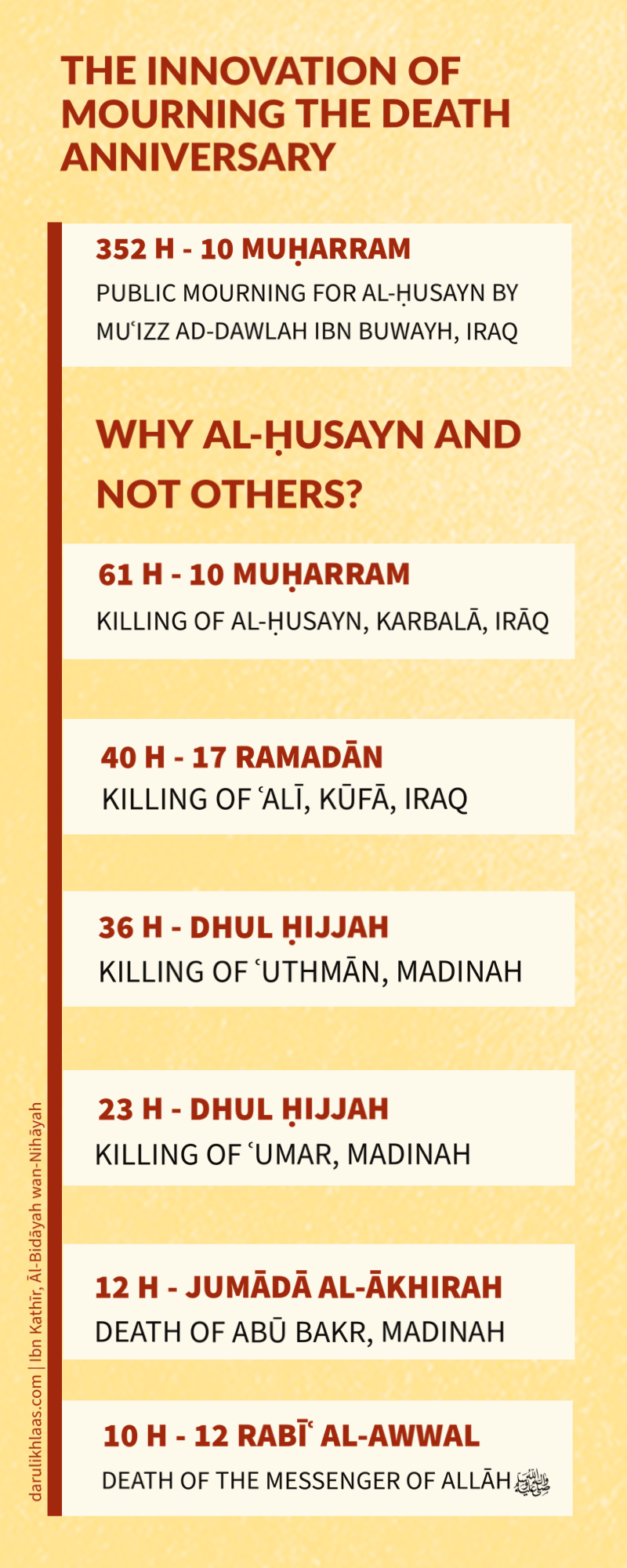
- “His father (ʿAlī) was killed on a Friday as he was leaving the masjid after Fajr prayer, on the seventeenth of Ramaḍān in 40 AH.
- ʿUthmān was better than ʿAlī according to Ahl as-Sunnah wal-Jamāʿah, and he was killed when he was besieged in his house during the days of at-Tashrīq in Dhul-Ḥijjah of 36 AH, with his throat cut from one jugular vein to the other, but the people did not take his death as an anniversary.
- ʿUmar ibn al-Khaṭṭāb was better than ʿAlī and ʿUthmān, and he was killed as he was standing in the miḥrāb, praying Fajr and reciting Qurʾān, but the people did not take his death as an anniversary.
- Abu Bakr aṣ-Ṣiddīq was better than him but the people did not take his death as an anniversary.
- The Messenger of Allāh ﷺ is the leader of the sons of Ādam in this world and the Hereafter, and Allāh (ﷻ) took him to Him as the Prophets died before him, but no one took the dates of their deaths as anniversaries on which they do what these ignorant Rāfidhīs do on the day that al-Ḥusayn was killed.”6
[What is said when afflicted by calamities]
“The best that can be said when remembering these and similar calamities is that which ʿAlī ibn al-Ḥusayn narrated from his grandfather (ʿAlī), the Messenger of Allāh ﷺ, who said:
❝There is no Muslim who is afflicted by a calamity and when he remembers it, even if it was in the dim and distant past, he says
(Innā lillāhi wa innā ilayhi rājiʿūn) (verily to Allāh we belong and unto Him is our return),
but Allāh will give him a reward like that of the day when it befell him.❞
Narrated by Imām Aḥmad and Ibn Mājah.” 7
“In Musnad Aḥmad it was narrated from Fāṭimah, daughter of Al-Ḥusayn -and she had witnessed his killing-, that the Prophet ﷺ said:
❝There is no Muslim, male or female, who is afflicted with a calamity, and when he remembers it, even after a long time, he says,
(Innā lillāhi wa innā ilayhi rājiʿūn) ‘Verily we belong to Allāh and unto Him is our return’
for that, but Allāh will renew (the reward) for him and will give him the same reward as on the day the calamity befell him.❞
Musnad Aḥmad 1734
This shows that the Sunnah when a calamity is mentioned, even if it were after a long while, is to do Istirjaʿ, as has come in the Qurʾān and the Sunnah
Allāh -The Most High- said:
﴿وَبَشِّرِ الصَّابِرِينَ – الَّذِينَ إِذَا أَصَابَتْهُمْ مُصِيبَةٌ قَالُوا إِنَّا لِلَّهِ وَإِنَّا إِلَيْهِ رَاجِعُونَ – أُولَئِكَ عَلَيْهِمْ صَلَوَاتٌ مِنْ رَبِّهِمْ وَرَحْمَةٌ وَأُولَئِكَ هُمُ الْمُهْتَدُونَ﴾
❝Give glad tidings to As-Sâbirûn (the patient). – Who, when afflicted with calamity, say: “Truly! To Allāh we belong and truly, to Him we shall return.” – They are those on whom are the Salawât (i.e. who are blessed and will be forgiven) from their Lord, and (they are those who) receive His Mercy, and it is they who are the guided ones.❞
Surah al-Baqarah 2:155-157” 8
[The two extreme innovations – Mourning & Rejoicing]
“The Rāfidhīs went to extremes in the state of Banī Buwayh (the Buyids) in the year 400H and thereabouts.9 The drums were beaten in Baghdad and other cities on the day of ʿĀshūrāʾ, and sand and straw was strewn in the streets and marketplaces, and sackcloth was hung on the shops, and the people expressed grief and wept. Many of them did not drink water that night, in sympathy with al-Ḥusayn, because he was killed when he was thirsty. Then the women went out barefaced, wailing and slapping their faces and chests, walking barefoot in the marketplaces, and other reprehensible innovations. What they intended by these and similar actions is to impugn the state of Banū Umayyah (the Umayyads), because he was killed during their era.
On the day of ʿĀshūrāʾ, the Nāṣibīs of Syria do the opposite of what the Rāfidhīs and Shīʿah do. They used to cook grains on the day of ʿĀshūrāʾ and do ghusl and perfume themselves, and wear their finest garments, and they took that day as an ʿEīd for which they made all kinds of food, and expressed happiness and joy, intending thereby to annoy the Rāfidhīs and be different from them.”10
“Because of the killing of al-Ḥusayn -may Allāh be pleased with him-, shayṭān caused the people to introduce two innovations: the innovation of mourning and wailing on the day of ʿĀshūrāʾ, by slapping the cheeks, weeping, and reciting eulogies and the innovation of rejoicing and celebrating. Therefore, some introduced mourning and others introduced celebration, so they regarded the day of ʿĀshūrāʾ as a day for wearing kohl, doing ghusl, spending on the family and making special foods. Every innovation is a going astray. None of the four imams of the Muslims or any other (scholars) regarded either of these things as recommended.”11
– Translated, arranged, subheadings and footnotes added by Abū Āsiyah Mużaffar -May Allāh rectify his affairs-
References:
- Ibn Kathīr -May Allāh have mercy on him-, Al-Bidāyah wan-Nihāyah
- Shaykh al-Islām Ibn Taymiyyah -May Allāh have mercy on him-, Minhāj as-Sunnah an-Nabawiyyah
Translator’s Footnotes:
- [1] (8/221) ↩︎
- The Rāfidhah meaning “the Rejecters”, named so due to their rejection of Zaid bin ʿAlī giving allegiance to the two rightly guided Caliphs, Abū Bakr and ʿUmar. They are an extreme Shīʿah sect who hold the twelver doctrine (Ithnā Ashʿariyyah) who accuse the mother of the believers, ʿĀʾishah radiyAllāhu ʿanhā, abuse the honour of the Prophet ﷺ, make takfīr of most of the Ṣaḥābah including Abū Bakr, ʿUmar, ʿUthmān and the wives of the Prophet – may Allāh be pleased with them all -. They also believe that the Qurʾān is incomplete. ↩︎
- This practice varies across regions and Shīʿah sects with slapping on one’s face, thumping on the chest, flogging, inflicting wounds oneself on the head or other parts of the body using blades, swords etc. ↩︎
- 10th Muḥarram 61 AH ↩︎
- [2] (151-152/8) ↩︎
- [1] (8/220) ↩︎
- [1] (8/220) ↩︎
- [2] (151-152/8) ↩︎
- 352H, Ordered by Muʿizz ad-Dawla Ibn Buwayh, may Allāh disgrace him [1] (11/277) ↩︎
- [1] (8/220) ↩︎
- [2] (4/554) ↩︎

