﷽
At-Taṣwīr (Image-making)
💠Image-making is divided into two categories based on the Muṣawwār1:
• The first category:
Making an image of that which has life —meaning, it breathes: such as humans, animals, birds, etc.— and the ruling on this will be discussed later.
• The second category:
Making an image of that which is non-living, such as an empty masjid, a mountain, a tree, and so on. This is permissible by consensus.
⚪️Image-making is divided into several categories based on its tools:
• The first category:
🔨 Carving on stones and the like, whether carving idols, birds, or statues of humans or animals.
• The second category:
🖋 Drawing animate objects with a pen.
• The third category:
📸 Still image-making using modern devices, known as ‘photography’.
• The fourth category:
🎥 Image-making using modern devices – but in motion, known as ‘video’.
🔸 Image-making is divided into categories based on the location of image:
• One category: is disregarded, such as a picture of a bird on a pillow or on a rug that is stepped on.
• The second category: is what is hung, such as a curtain or the like.
• The third category: is what is hung on walls.
💡 The wisdom behind the above is that image-making is divided into two categories:
• One category: that which has no life, and this is permissible by consensus.
• Another category: that which has life, with its four categories. The ruling [that it is forbidden] in the four categories is evident from the wisdom behind the prohibition of image-making, as stated by the author2 -may Allāh have mercy on him-;
💠 The wisdom behind its prohibition is as follows:
1⃣ Firstly, it is feared that it may lead to worshipping other than Allāh, whether for a long or short period of time, as the people of Nūḥ did when they carved idols. The first form of polytheism in the world was caused by the carving of these idols, as Allāh -the Almighty- recounted in Sūrah Nūḥ:
﴿وَقَالُوا۟ لَا تَذَرُنَّ ءَالِهَتَكُمۡ وَلَا تَذَرُنَّ وَدࣰّا وَلَا سُوَاعًا﴾
❝And they have said: ‘You shall not leave your gods, nor shall you leave Wadd, nor Suwāʿ❞
Nūḥ 71:23
2️⃣The second matter is: From the wisdom behind it: Some of it is not feared to be worshipped, but rather it is an imitation of the creation of Allāh -the Most High-. For example, if a man carved the image of a bird, the Prophet ﷺ would say:
«قَالَ اللَّهُ عَزَّ وَجَلَّ : وَمَنْ أَظْلَمُ مِمَّنْ ذَهَبَ يَخْلُقُ كَخَلْقِي، فَلْيَخْلُقُوا ذَرَّةً، أَوْ لِيَخْلُقُوا حَبَّةً أَوْ شَعِيرَةً»
“[Allāh -the Most High- says]:
‘Who are most unjust than those who try to create something like My creation? Let them create even a smallest ant, a wheat grain or a barley grain.’”
Al-Bukhārī 7559
And it will be said to them on the Day of Resurrection,
«أَحْيُوا مَا خَلَقْتُمْ»
“Bring to life what you have created or what you have shaped.”
Al-Bukhārī 7557
3⃣ The third wisdom is: Among the types of image-making that is feared for people to be tempted by it, whether immediately or in the future – as will be mentioned – such as: if a picture of the Prophet ﷺ were placed now, there is a fear that it would be immediately worshipped.
4⃣ The fourth matter: Some of it is harmful, such as making images of women or children and threatening them with those images to commit an evil act.
5⃣ The fifth matter: Among the wisdoms is that angels do not enter a house in which there is an image, as the Prophet ﷺ said in the ḥadīth in which Jibrīl said to him:
«إِنَّا لاَ نَدْخُلُ بَيْتًا فِيهِ صُورَةٌ»
“We [the angels] do not enter a house which contains an image.”
Al-Bukhārī 3227
6⃣ Among the wisdoms is a sixth wisdom; There are some of which the wisdom is unknown, but we only obey the command of the Prophet ﷺ to stay away from it, such as his ﷺ saying:
«لعن الله المصوِّر»
“Allāh’s curse is upon the image-maker.”
The definite article is general, referring to all four types of imaging devices mentioned above, and to the Prophet’s ﷺ saying:
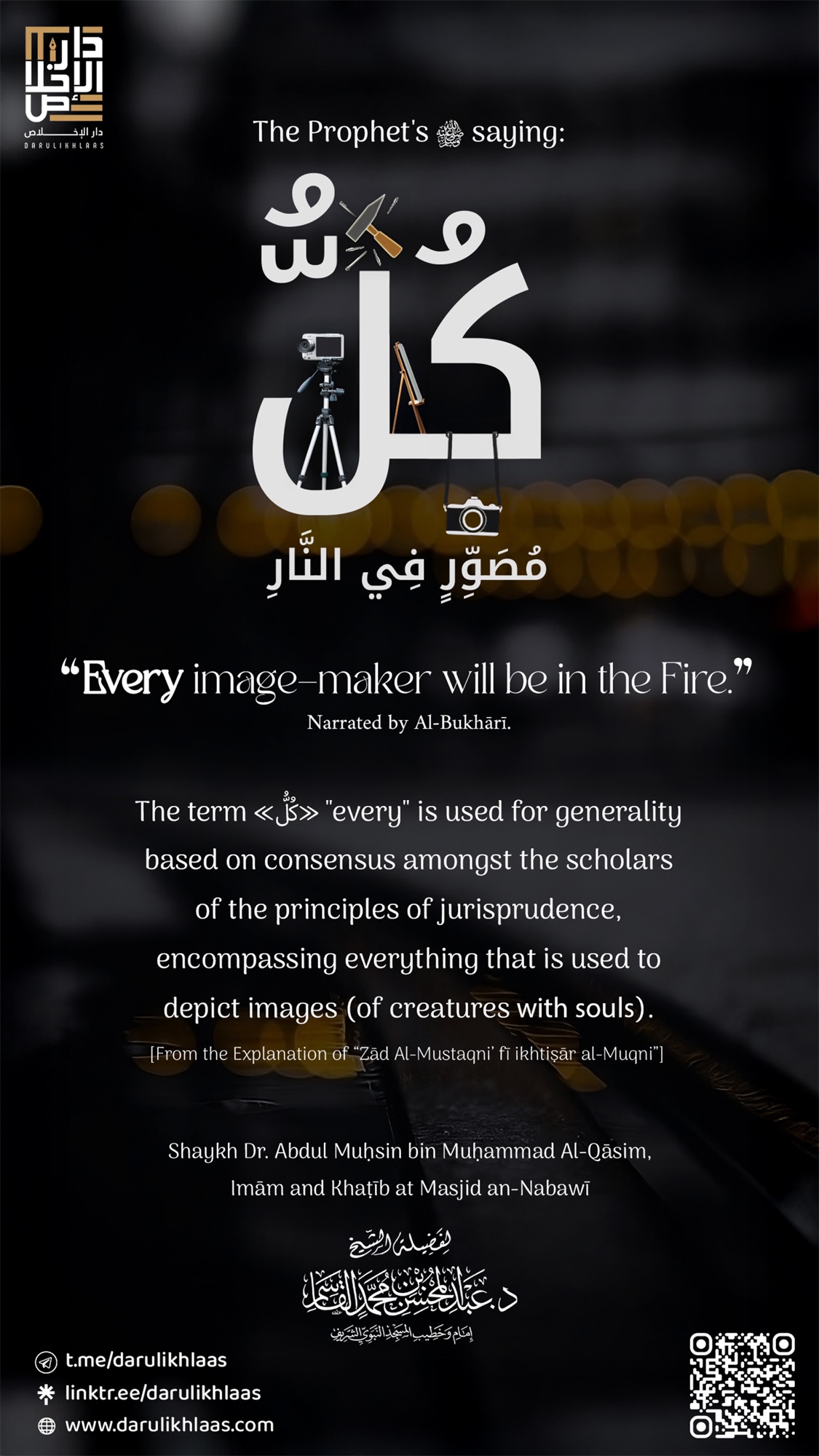
«كُلُّ مُصَوِّرٍ فِي النَّارِ»
“Every image-maker will be in the Fire.”
Narrated by Al-Bukhārī
The word “every” is agreed upon by the scholars of the principles of jurisprudence (usūl al-fiqh) for generality, encompassing everything that is used to depict images.
❓If it is asked: Which of the four aforementioned types is most severe in prohibition?
🔹 We say it is divided into two categories:
💠 Regarding Muḍāhāt (imitating) Allāh’s creation – the most severe of these is the stone carving, followed by drawing with a pen or brush.
💠 The most severe of these in terms of temptation are those in motion (pictures), followed by the stationary (photos).
💡 This is demonstrated by examples:
📍If an image of the Prophet ﷺ was carved, another drew it, a third photographed it, and a fourth depicted it in motion, which of them would be more fascinating and captivating to the hearts?
Undoubtedly, the moving, then the stationary, then the drawing, then the sculpture.
🔸 The same would apply if pictures were taken of the Companions -may Allāh be pleased with them-, individually, in battle, or otherwise, according to the previous classification.
🔗 As for comparing image-making to the capturing of a shadow, this is an analogical comparison with significant difference (Qiyās maʿa al-fāriq). Image-making is divided into two categories based on the shadow:
🔵 A category that disappears, such as seeing oneself or someone else in the moonlight on water, and a category like seeing oneself in a mirror. This is permissible because it is not permanent. That is, if someone sees themselves in a mirror and then leaves, and a month later we go to the mirror and don’t see their image, this includes image-making that is not permanent and the image is not retained. There is no problem with this, but it is feared that it could be used as a means to retain it. There is a difference between the capturing of a shadow and what is analogous to a mirror and the like.
– Shaykh Dr. ʿAbdul Muḥsin bin Muḥammad Al-Qāsim -may Allāh preserve him-, Imām and Khaṭīb at Masjid an-Nabawī
– From the Explanation of “Zād Al-Mustaqniʿ fī ikhtiṣār al-Muqniʿ” on 12/05/1437H
– His (author) saying “It is forbidden to take pride in clothing or other things, and to take pictures and use them.”
– Translated by Abū Āsiyah Mużaffar -may Allāh forgive him, his mashāyikh, his parents, his family and all the Muslims-
Source: https://t.me/FawaidAlQasim/166
Translator’s Footnotes:
- The object which is depicted in the image ↩︎
- Abū an-Najah Mūsā bin Aḥmad Al-Maqdisī Al-Ḥajjāwī (895-968H) ↩︎
🔰 التصوير 🔰
💠 ينقسم إلى قسمين من ناحية المصوَّر:
• القسم الأول:
تصوير ما فيه روح – يعني: يتنفس، مثل: الإنسان، والحيوان، والطيور، وغير ذلك -وهذا سيأتي حكمها-.
• القسم الثاني:
تصوير ما لا روح فيه مثل: المسجد وهو خالٍ، الجبل، الشجر، وهكذا؛ وهذا جائز بالإجماع.
⚪ وينقسم التصوير من ناحية آلته إلى عدة أقسام:
• القسم الأول:
🔨 النحت على الحجارة ونحوها، سواءً نحْت أصنام أو نحت طيور أو تماثيل إنسان أو حيوان.
• والقسم الثاني:
🖋 وهو رسم ما فيه روح بالقلم.
• والقسم الثالث:
📸 التصوير الثابت بالآلات الحديثة، ما يسمى بـ ‘التصوير الفوتغرافي’.
• القسم الرابع:
🎥 التصوير بالآلات الحديثة – لكنه متحرك، وهو ما يسمى بـ ‘الفيديو’.
🔸 وينقسم التصوير من ناحية موضِع الصورة إلى أقسام:
• قسم: يكون منبوذاً، مثل: صورة طائر على وسادة، أو على سجاد يُوطئ.
• والقسم الثاني: ما يُعلَّق كالستار ونحوه.
• والقسم الثالث: ما يُعلَّق على الحيطان.
💡 وحكمة مما سبق أن التصوير ينقسم إلى قسمين:
• قسم: ما لا روح فيه، وهذا جائز بالإجماع.
• وقسم: ما فيه روح بأقسامه الأربعة، والحُكم [أنه محرّم] في الأقسام الأربعة يتبين من الحِكمة في تحريم التصوير، كما قاله المصنف رحمه الله؛
💠 والحكمة من تحريمه ما يلي:
1⃣ أولاً؛ منه ما يُخشى منه العبادة من دون الله إذا طال الزمن أو قصر، كما فعل قوم نوح بعبادة الأصنام لما نحتوها، وأول شرك في العالم سببه نحت هذه الأصنام، كما قص الله عز وجل في سورة نوح: ﴿وَقالوا لا تَذَرُنَّ آلِهَتَكُم وَلا تَذَرُنَّ وَدًّا وَلا سُواعًا﴾ [نوح: ٢٣].
2⃣ والأمر الثاني؛ من الحكمة فيه: منه ما لا يخشى من أن يُعبد، وإنما فيه مضاهاة لخلق الله سبحانه وتعالى مثل: لو نحت رجلٌ صورة طائر، النبي ﷺ يقول: [يَقُولُ اللَّهُ عَزَّ وَجَلَّ]: «ومَنْ أظلمُ ممن ذهبَ يخلقُ كخلقي، فليخلقوا ذرة أو حبة أو شعيرة»، ويُقال لهم يوم القيامة أحيوا ما خلقتم أو ما صورتم.
3⃣ وحكمة ثالثة؛ من أنواع التصوير يخشى أن يُفتتن به، سواءً في الحال أو المآل -كما سيأتي- مثل: لو وُضعت صورة النبي ﷺ الآن، يخشى أن تُعبد فوراً.
4⃣ والأمر الرابع؛ منه ما فيه مفسدة، مثل: تصوير بعض النساء أو الصبيان، وتهديدُهم بتلك الصور لفعل أمر منكر.
5⃣ والأمر الخامس؛ من الحكم أن منه ما لا تدخل الملائكة البيت الذي فيه صورة، كما قال النبي ﷺ في الحديث الذي قال جبريل له : “إنّا [الملائكة] لا ندخل بيتاً فيه صُورة”.
6⃣ ومن الحِكم، حكمة سادسة؛ منه ما لا تُعلم فيه الحكمة، وإنما نمتثل أمر النبي ﷺ بالبُعد عنه، كقوله ﷺ: «لعن الله المصوِّر» والألف واللام للعموم، لجميع أنواع آلات التصوير السابقة الأربعة، ولقول النبي ﷺ: «كُلُّ مُصَوِّرٍ فِي النَّارِ» رواه البخاري، ولفظة «كُلُّ» بإتفاق الأصوليين للعموم، فتشمل جميع ما يصوَّر به.
❓ فإذا قيل: الأنواع الأربعة السابقة، أيهم أشد حرمة؟
🔹 نقول ينقسم إلى قسمين:
💠 في المضاهاة لخلق الله – أعظمها في التحريم: النحت على الحجارة، ثم يليه الرسم بالقلم أو الريشة.
💠 وأشدها تحريماً من ناحية الٱفتتان: المُتَحَرِّك ثم الثابت.
💡 ويتبين ذلك بالأمثلة؛
📍 لو نحتت صورة النبي ﷺ، وآخر رسمها، وثالث صوّرها، والرابع صوّرها بالمتحرك، أيهما أعظم ٱفتتان وتَلَهَّف القلوب لها؟
لا شك المتحرك، ثم الثابت، ثم الرسم، ثم النحت.
🔸 وكذلك لو كانت صور الصحابة رضي الله عنهم، سواءً على أفرادهم أو في المعركة أو غير ذلك على التقسيم السابق.
🔗 وأما قياس التصوير على حبس الظل – فهذا قياس مع الفارق، فالتصوير ينقسم إلى قسمين من ناحية الظل:
🔵 قسم يزول، مثل: رؤية الشخص نفسه أو غيره في ضوء القمر على الماء، ومثل رؤية الشخص نفسه بالمرآة، هذا لا بأس به؛ لأنه غير ثابت؛ يعني لو شخص رأى نفسه بالمرآة ثم ذهب وبعد شهر نذهب للمرآة ما نرى صورته؛ ومنه التصوير الذي لا يثبت ليس فيه حبس للصورة – هذا لا بأس به، لكن يخشى أن يتخذ ذريعة لحبسها، وهناك فرق بين حبس الظل وبين ما هو يقاس على المرآة ونحوه.
____________________
📅 من شرح ‘زاد المستقنع في ٱختصار المقنع’، بتاريخ: ١٤٣٧/٠٥/١٢ ھ
📖 قوله: “ويحرم: الخيلاء في ثوب وغيره، والتصوير وٱستعماله.”
•┈┈┈┈••✦🔹✦••┈┈┈┈•
فوائد علمية للشيخ د. عَبدالمُحْسِن بن مُحَمَّد القَاسِم وَفَّقَهُ اللَّهُ
إمام وخطيب المسجد النبوي

