بسم الله الرحمن الرحيم
All praise is due to Allāh, and peace and blessings be upon the Messenger of Allāh. This is a response to a question submitted to the esteemed Shaykh Yaḥya bin ʿAlī al-Ḥajūrī -may Allāh preserve him- on Tuesday, the 5th of Rabīʿ al-Awwal, 1432 AH. He said:
Among the things that are emphasized is the distinction (tamayyuz) that scholars have been calling for and continue to call for, from the time of Imām Aḥmad and before him until this day. The schools of those who disagree are separate from the schools of Ahlus-Sunnah. There should be neither excess nor negligence. We do not want extremism (ghuluw) nor laxity (tamayyuʿ); we want the truth brought by the Messenger of Allāh ﷺ. In the authentic ḥadīth, it is narrated,
“I fear that if I change, I will go astray.”
Sunan Abī Dāwūd 2970, Graded Ṣaḥīḥ by Al-Albānī
This is what Abu Bakr -may Allāh be pleased with him- said. Steadfastness on the truth is a blessing from Allāh, even if a person remains by himself. Allāh praised His Prophet Ibrāhīm -peace be upon him- for upholding the truth alongside a great nation that Allāh despised at that time. Allāh -the Exalted- said,
﴿ إِنَّ إِبْراهِيمَ كانَ أُمَّةً قانِتاً لِلَّهِ حَنِيفاً وَلَمْ يَكُ مِنَ الْمُشْرِكِينَ * شاكِراً لِأَنْعُمِهِ اجْتَباهُ وَهَداهُ إِلى صِراطٍ مُسْتَقِيمٍ ﴾
“Verily, Ibrāhīm was an Ummah (a leader having all the good righteous qualities), or a nation, obedient to Allāh, Ḥanīf (i.e. to worship none but Allāh), and he was not one of those who were Al-Mushrikūn. (He was) thankful for His Favours. He chose him (as an intimate friend) and guided him to a Straight Path”
Sūrah An-Nahl 16:120-121
The Ahlus-Sunnah must strengthen their unity and join forces in this endeavor. Those who seek to sow discord, create unrest, and incite strife among the Ahlus-Sunnah are told: either avoid discord, or you will only harm yourself. It is unacceptable that if one, two, or even ten people are led astray, they will then lead others astray. This indicates a lack of proper understanding and adherence to the correct path. Ultimately, the truth will prevail and be victorious.
﴿ وَلَيَنصُرَنَّ ٱللَّهُ مَن يَنصُرُهُۥٓ ۗ إِنَّ ٱللَّهَ لَقَوِىٌّ عَزِيزٌ ﴾
“Verily, Allāh will help those who help His (Cause). Truly, Allāh is All-Strong, All-Mighty.”
Sūrah Al-Ḥajj 20:40
﴿ إِنْ تَنْصُرُوا اللَّهَ يَنْصُرْكُمْ ﴾
“If you support Allāh, He will support you”
Sūrah Muḥammad 47:7
Whoever supports Allāh’s religion, Allāh will support him, whether in this country or elsewhere, regardless of their large numbers, the likes of the Tablīghiyyah, don’t be concerned by it, Jazākumullāhu khayran.
We receive questions like this: “We heard that they have been mobilizing and announcing for weeks, even arranging buses at their own expense for a gathering to inaugurate the ḥizbī masjid in Al-Fuyoush. This inauguration is an innovation. There’s no evidence that the Prophet ﷺ ever gathered his companions to inaugurate his masjid. Neither the companions nor anyone else in the world would say, ‘“Come, Abu Bakr”, “come, ʿUmar”, “come, ʿUthman”, inaugurate such-and-such masjid for us,’ and so on with the imāms after them. All of this is from that which is newly-introduced. Now they have begun to liken masājid to what some ignorant people do when inaugurating hotels, companies, and institutions.”
And they added to that the recitation of the beginning of Sūrah Al-Fatḥ
﴿ إِنَّا فَتَحْنَا لَكَ فَتْحًۭا مُّبِينًۭا ﴾
“Verily, We have given you (O Muḥammad ﷺ) a manifest victory.”
Sūrah Al-Fatḥ 48:1
This is manipulation, my brothers! This opening in this manner is an innovation, and they have no proof for it. They say that when the masjid is finished, “We want Shaykh so-and-so to open it with a lecture”. This is an innovation, and whoever does it after the evidence has been presented to him and he persists in it is an innovator in this matter.
The next affair is that we, the people of the Sunnah, are not concerned with whether there are many people or few. What concerns us is purity and clarity, and what draws us closer to Allāh -the Almighty- through adherence to the Sunnah and steadfastness upon it. A Prophet would come with one man, a Prophet would come with two men, and a Prophet would come with no one.1
However, praise be to Allāh, the Ahlus-Sunnah in Yemen are firmly devoted to the Sunnah, to purity and clarity, and to remaining steadfast in their faith without alteration or change. As for these new ḥizbīs, they are determined to follow in the footsteps of their predecessors from the ḥizbiyyūn, such as Abul-Ḥasan al-Miṣri and his like. We were informed that he used to send money from the Jamʿiyyah al-Birr‘s funds to some of his associates in such-and-such town to purchase sacrificial animals, on the condition that they would come to him with an invitation and gather the people to attend. Except that they saw others going to have food, so they would go along only if they invited and the invitation was general.
And likewise in Al-Fuyoush, they gather around the sheep of Brother Muḥammad Faraʿa—may Allāh guide him—while he knows the words of Allāh -the Almighty-:
﴿ وَلَا تَعَاوَنُوا عَلَى الْإِثْمِ وَالْعُدْوَانِ ﴾
“But do not help one another in sin and transgression”
Sūrah Al-Māʾidah 5:2
They round up people from the streets. By Allāh, even if they filled the area from ʿAden to Hudeidah, we would not show concern about them. In India, millions of people gather and perhaps the Muslim Brotherhood may gather, along with common folk, for lectures by ʿAmr Khaled, Al-Qarnī, Al-Zindānī, Al-Qaraḍāwī, or others. Thousands are gathered by their buses and their propaganda from numerous cities and villages. These empty crowds, devoid of righteousness, offer neither benefit nor dignity. These partisans gather to listen to the pronouncements of that disgraced man in his old age, the standard-bearer of Shayṭān in this new partisanship, Muḥammad bin ʿAbdul Wahhab Al-Waṣṣābī. This gathering is but froth, and Allāh -the Almighty- says:
﴿ فَأَمَّا ٱلزَّبَدُ فَيَذْهَبُ جُفَآءًۭ ۖ وَأَمَّا مَا يَنفَعُ ٱلنَّاسَ فَيَمْكُثُ فِى ٱلْأَرْضِ ۚ ﴾
“Then, as for the foam it passes away as scum upon the banks, while that which is for the good of mankind remains in the earth.”
Sūrah ar-Raʿd 13:17
By Allāh, even if you gathered all the women of Rowaishan2 and brought them to have dinner, or to attend the lecture, or for the sake of widespread media coverage or because so-and-so will be giving a lecture on the phone, this would not absolve you of partisanship (ḥizbiyyah) and froth.
People will have dinner, and after they have dinner they will go out and say: “By Allāh, these people have changed. We only knew this from the partisans, and they have no knowledge. The knowledge is there in Dammaj, but these people are lost and have nothing but meat.”
This is clear, and meat and money are not in themselves an invitation. You have a lesson in Abul-Ḥasan, for he was stronger than you and had a larger following, and you used to call him “the Imām“, then he was lost on the path that you are now walking on.
The daʿwah (to Islam) is knowledge. The daʿwah is the Sunnah. The Sunnah was established on poverty from the very first day, and poverty did not harm it. So we say that this convoluted talk and the stories of Muḥammad bin ʿAbdul Wahhāb (Al-Waṣṣābī) and so on—this is not daʿwah. This is merely an echo of their blatant partisanship.
By Allāh, even if Imam Aḥmad bin Ḥanbal -may Allāh have mercy on him- were present amongst you, he would not benefit you in this deplorable state. You are ḥizbīyyun, known to everyone far and near.
We advise Shaykh Muḥammad Al-Imām not to make his center like the schools of Al-Ikhwān Al-Muslimūn, where whenever there is a Muḥāḍarah (lecture) by these ḥizbīyyun, they load them onto buses to fill up the masjid for their lecture.
This is a good fatwa from the Permanent Committee regarding the ruling on gatherings for the opening of masājid:
Ruling on opening Masājid with celebrations and gatherings for that purpose
Q: Praise be to Allāh, and peace and blessings be upon His Messenger, his family and companions.
The Permanent Committee for Scholarly Research and Iftāʾ has reviewed the question submitted to His Eminence the Grand Mufti, the text of which is as follows:
“When a new masjid is built near us, and they intend to begin praying Ṣalāh, people from neighboring towns are invited. They then gather for what is called the Iftitāḥ (opening) of the masjid. What is the ruling on their coming for this purpose? Does the Ḥadīth: “A journey is not undertaken except to three masājid…” indicate its prohibition? If this action is permitted, what is the evidence for it? Is this action permitted due to the Ḥadīth that some of the Companions called the Prophet ﷺ to pray in a corner of his house so they could make it a place of Ṣalāh?
In addition to the above, can we establish its allowance from the story of “Masjid aḍ-Ḍirār”3, the fact that our Lord did not forbid it due to the mere intention of visiting it, rather the prohibition was because it was built to cause dissention and disbelief. Please enlighten us, may Allāh reward you.”
A: All praise is for Allāh. Masājid are opened by praying Ṣalāh in them, maintaining them with the remembrance of Allāh, reciting the Qurʾān, Tasbīḥ, Taḥmīd, Tahlīl, teaching Islamic knowledge, and other actions that honour the status of masājid.
Allāh -the Most High- said,
﴿ فِي بُيُوتٍ أَذِنَ اللَّهُ أَنْ تُرْفَعَ وَيُذْكَرَ فِيهَا اسْمُهُ يُسَبِّحُ لَهُ فِيهَا بِالْغُدُوِّ وَالْآَصَالِ * رِجَالٌ لَا تُلْهِيهِمْ تِجَارَةٌ وَلَا بَيْعٌ عَنْ ذِكْرِ اللَّهِ وَإِقَامِ الصَّلَاةِ وَإِيتَاءِ الزَّكَاةِ يَخَافُونَ يَوْمًا تَتَقَلَّبُ فِيهِ الْقُلُوبُ وَالْأَبْصَارُ * لِيَجْزِيَهُمُ اللَّهُ أَحْسَنَ مَا عَمِلُوا وَيَزِيدَهُمْ مِنْ فَضْلِهِ وَاللَّهُ يَرْزُقُ مَنْ يَشَاءُ بِغَيْرِ حِسَابٍ ﴾
“In houses (masājid) which Allāh has ordered to be raised and that His name is mentioned; exalting Him within them in the mornings and evenings. By men whom neither trade nor sale distracts from the remembrance of Allāh, from performing Ṣalāh nor from giving the Zakāh. They fear a day when hearts and eyes will [fearfully] turn about – that Allāh may reward them according to the best of their deeds, and increase them out of His Grace. And Allāh provides without measure to whom He wills”
Sūrah an-Nūr 24:36-38
With this and similarly by offering advice, admonishments and counsel. The Messenger of Allāh ﷺ used to maintain the masājid like this, and he was followed in that by the rightly-guided caliphs, the other Companions, the Imāms of guidance after him –may Allāh be pleased with them and have mercy on them-. All goodness is in following their guidance and adhering to their example in opening masājid and maintaining them as they did, with acts of worship and other similar rituals of Islām.
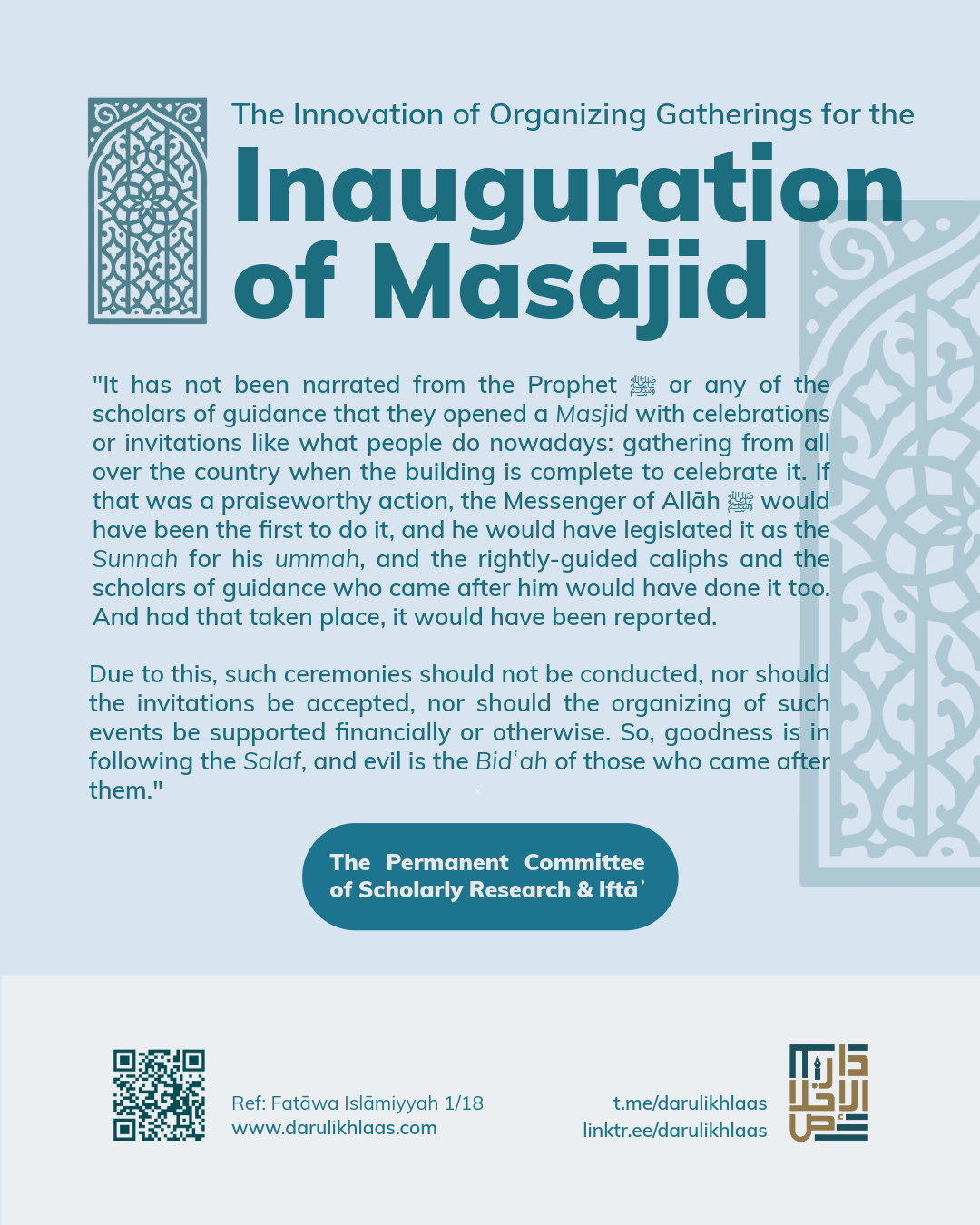
It has not been narrated from the Prophet ﷺ or any of the scholars of guidance that they opened a Masjid with celebrations or invitations like what people do nowadays: gathering from all over the country when the building is complete to celebrate it. If that was a praiseworthy action, the Messenger of Allāh ﷺ would have been the first to do it, and he would have legislated it as the Sunnah for his ummah, and the rightly-guided caliphs and the scholars of guidance who came after him would have done it too. And had that taken place, it would have been narrated.
Due to this, such ceremonies should not be conducted, nor should the invitations be accepted, nor should the organizing of such events be supported financially or otherwise. So, goodness is in following the Salaf (pious predecessors), and evil is the Bidʿah of those who came after them.
The fact that one of the Companions invited the Messenger of Allāh ﷺ to his house to pray two Rakaʿāt so that he could take that as a Muṣallah for Nafl prayers is not a proof to justify this modern practice of what is today known as “Iftitāḥ (opening ceremonies) of the masājid”. This is because the Companion did not invite the Prophet ﷺ to a ceremony; rather, he invited him to pray Ṣalāh, nor did the Prophet ﷺ undertake a journey to pray that Ṣalāh.
In addition to this, undertaking a journey to attend that celebration or even for Ṣalāh in that Masjid comes under the general prohibition of travelling to pray in masājid other than the three known masājid.4
So we should avoid such innovated customs and be content with regards to masājid and other matters with what was done at the time of the Messenger of Allāh ﷺ and the scholars of guidance –may Allāh have mercy on them-.
And may Allāh bless our Prophet Muḥammad, his family and his Companions and grant them peace.
– The Permanent Committee, Fatāwa Islāmiyyah Vol. 1 Page 18
Source: https://sh-yahia.net/show_art_26.html
Translated by: Abū Āsiyah Muzaffar bin Ḥussain -may Allāh forgive him, his parents, his mashāyikh, his family and all the Muslims-
Translator’s Footnotes:
- As has come in the ḥadīth of Ibn ʿAbbas in Ṣaḥīḥ al-Bukhārī 5752 ↩︎
- A Qaḥṭānī tribe with a large presence in Yemen. ↩︎
- Masjid aḍ-Ḍirār was a masjid built by the Munāfiqūn (hypocrites) during the time of the Prophet ﷺ to cause harm to the Muslims and spread Kufr. ↩︎
- Narrated Abu Hurairah: The Prophet (ﷺ) said, “Do not set out on a journey except for three masājid i.e. Al-Masjid Al-Ḥarām, the masjid of Allāh’s Messenger (ﷺ) , and the masjid of Al-Aqsa, (Jerusalem).” Ṣaḥīḥ al-Bukhārī 1189 ↩︎

