Verily! Aṣ-Ṣafā and Al-Marwah (two mountains in Makkah) are of the Symbols of Allāh. So it is not a sin on him who perform Ḥajj or ʿUmrah (pilgrimage) of the House (the Kaʿbah at Makkah) to perform the going (Ṭawāf) between them (Aṣ-Ṣafā and Al-Marwah).
Al-Baqarah 2:158
Where-in
﴿ یَطَّوَّفَ بِهِمَاۚ ﴾
Means: To perform Saʿī between them as the Prophet ﷺ did. He went towards Aṣ-Ṣafā from its door and recited:
Verily! Aṣ-Ṣafā and Al-Marwah are of the Symbols of Allāh.
Then he said,
«أَبْدَأُ بِمَا بَدَأَ اللهُ بِهِ»
I begin with what Allāh has begun with.
In another narration,
«ابدءوا بما بدأ الله به ، ثم رقى على الصفا حتى رأى الكعبة ثم نزل ومشى إلى المروة وصعد عليها حتى رأى البيت ثم نزل ومشى إلى الصفا حتى أكمل سبعة أشواط.»
I begin with what Allāh began with. Then he climbed Aṣ-Ṣafā until he saw the Kaʿbah, then he descended and walked to Al-Marwah and climbed it until he saw the House, then he descended and walked to Aṣ-Ṣafā until he completed seven circuits.
And he said,
«خذوا عني مناسككم»
Learn your rituals (by seeing me performing them)
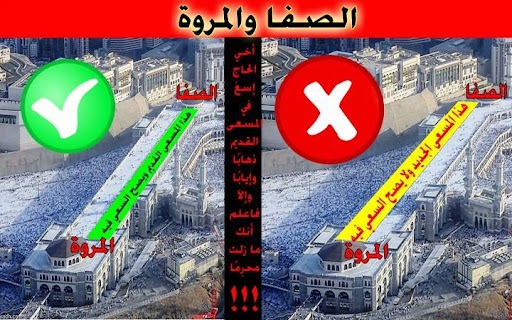
The Muslims have inherited this from one generation to another, performing Saʿī between Ṣafā and Marwah, and the bayniyyah (betweenness) requires that one should not go beyond what is between them in Saʿī, because whoever goes beyond them is not considered to have performed Saʿī between Ṣafā and Marwah, and it is a matter of worship in which there is no scope for opinion. Therefore generations of Muslims have preserved the place of Saʿī between Ṣafā and Marwah despite the expansions that the Grand Masjid has undergone, and none of the Muslim rulers wished to increase the area of Saʿī beyond what was present and known.
His Eminence Shaykh Muḥammad bin Ibrahīm, the Mufti of Saudi Arabia -may Allāh have mercy on him- even said: “Considering that Ṣafā according to Islamic law is the smooth rocks that are located at the foot of Mount Abu Qubais, and because the aforementioned rocks are still present now and clearly visible, and because the three old contracts did not accommodate the entire width of the rocks, the committee [i.e. the one formed to look into the Masʿā] saw that there is no objection to expanding the aforementioned ascent to the extent of the width of Ṣafā.”
He -may Allāh have mercy on him- said: “After considering the aforementioned proposal, [The aforementioned proposal is to break the rocks of Ṣafā and Marwā as they were in the beginning, to facilitate the completion of the Saʿī between Ṣafā and Marwah in the carts (wheelchairs)].” He -may Allāh have mercy on him- said: “We strived for what was possible from our end, and if we were to open the door to proposals in the sacred sites (Mashāʿir), that would lead to the future stage being set for interpretations and a window through which one can enter to alter the sacred sites (Mashāʿir) and rulings of Ḥajj .”
– From the compilation of Fatāwā of Shaykh Muḥammad (5/148, 146)
I say: may Allāh have mercy on the Shaykh and grant him a spacious place in Paradise for preserving this sacred site about which Allāh said:
O you who believe! Violate not the sanctity of the Symbols of Allāh
Al-Māʾidah, Ayah 2
Imām Ibn Kathīr said:
Ibn ʿAbbās said: “He meant by that the rituals of Ḥajj.”
Mujāhid said:
“Aṣ-Ṣafā and Al-Marwah, and the sacrificial animal are the symbols of Allāh.” Volume 3, Page 9
Shaykh Muḥammad Rashīd Riḍā1 said in Tafsīr al-Manār (2/43-44):
“Ṣafā and Marwah are two mountains or on two mountains in Makkah and the distance between them is 760 and a half cubits and Ṣafā is towards the Sacred House. The buildings have risen above them and what is between them has become a market – until he said: In this type, one stops at the text as per what Allāh -the Most High- has legislated, it is not added to nor is it deducted from and it is not compared with and no one’s opinion or judgment is taken into account in it. Because if people were permitted to add to the rituals of religion by their judgment in the generality of a word or an analogy, it would be possible for the rituals of Islam to become manifold of what they were in the time of the Prophet -may Allāh bless him and grant him peace- up until most people would not differentiate between the original legislator and the intruding innovator.”
Imam Ash-Shawkānī said in Fatḥ Al-Qadīr (1/139),
“Ash-Shaʿāʾir is the plural of shaʿīrah, which is a symbol, i.e. one of the symbols of His rituals, and what is meant by it is the place of worship that Allāh has indicated as symbols for the place of the standing, the place of Ṣafā , and the place of sacrifice.”
“Meaning among His landmarks and places of His worship.”
Imām Al-Baghawī said in his interpretation (1/132),
“Verily, he signified by them the two well-known mountains in Makkah at the two ends of the Masʿā, and that is why he included the definite article (Al-) in them. The Shaʿāʾir of Allāh are the signs of His religion. Its origin is from the word “ishʿār” which means to inform, and its singular is “shaʿīrah”. Everything that is a sign of acts of worship by which one draws close to Allāh, such as prayer, supplication, and sacrifice, is a “shaʿīrah”. So the Maṭāf, the mawqif (place of standing), and the sacrifice are all symbols of Allāh. The same applies to the sacred places, and what is meant by sacred places here are the rituals that Allāh made signs of His obedience. Ṣafā and Marwah are among them.”
It has become clear from these narrations that the meaning of Ṣafā and Marwah being among the symbols of Allāh is that they are markers for the beginning and end of the circuit of the Saʿī, and the Saʿī is between them, going and returning. So whatever of the Saʿī is outside of their alignment is not valid, just as whoever goes beyond them, the beginning and end, has added to the Saʿī.
Therefore, the Saʿī is confined to what is between them. Each circuit begins from Ṣafā and ends with Marwah. Ṣafā and Marwah are two elevated landmarks that one ascends and descends from during the Saʿī. Therefore, the practice of the Muslims in the Saʿī was to adhere to the area of the Saʿī in length and width between Ṣafā and Marwah, and whatever goes beyond them is not part of the Saʿī. It is not permissible to increase the area of the Saʿī beyond what is between Ṣafā and Marwah in length and width. No one dared to increase that throughout history, even in the era of ignorance. It is also not permissible to increase the area of Mina, Muzdalifah and ʿArafah outside their borders, because increasing that is a change in the symbols of Allāh that He has specified for His servants and He informed us that honoring them and adhering to them is from the piety of the heart, so Allāh the Almighty said:
O you who believe! Violate not the sanctity of the Symbols of Allāh
Al-Māʾidah 5:2
And that is by increasing them, decreasing them, or underestimating them, and from them are Ṣafā and Marwah. It is not permissible to increase what is present and prominent from them and has been inherited through the centuries. Digging to search for an increase in what is present is an excavation and a burden that Allāh and His Messenger did not command. Moreover, what is buried under the ground cannot be included in the prominent monument without evidence from the Book or the Sunnah. Moreover, it does not take the ruling of the landmark and the prominent monument in terms of ascending to it and descending from it as the Prophet ﷺ did. Rather, it is either left as it is, lowered, and one descends to it and ascends from it, which is the opposite of what is prescribed, or a building is built above it that is equal to the monument, and this building does not take the ruling of the monument, and what is between the two buildings does not take the ruling of the Masʿā. As for those who issued a fatwa that the increase has the same ruling as the Masʿā, they did not rely on anything. They differed in their evidence. Some of them say that the issue is a matter of difference of opinion and that the ruler has the right to choose what he sees as in the interest.
We say to them: When did the disagreement occur? It was not known that there was any disagreement on the issue until recently, and the one who disagreed did not rely on a precise proof. Also, the issue of the Masʿā is an issue of worship, not a matter of ijtihād (independent reasoning and interpretation) and consideration, so the sacred sites are a matter of revelation, and there is no room for ijtihād in them.
They say that expansion is necessary due to the intense crowding. We say to them: The expansion should be horizontal, by adding more floors above the Masʿā, just as the floors above the Jamarāt, as the Lajnah ʿIlmiyyah (Scientific Committee) headed by Shaykh Muḥammad bin Ibrahīm saw fit, and as per the decision of the Council of Senior Scholars. Because the atmosphere takes the ruling of the base ground.
Those who testified that the Ṣafā and Marwah expanded, their testimony contradicts the observed reality and contradicts the common practice of Muslims, which considers the Masʿā to be limited to the prominent areas between Ṣafā and Marwah. If they had known that there was an increase, they would have included it, because it is not permissible to diminish the land of the sacred sites or increase it, as this contradicts their sanctity. Accordingly, it is not permissible to increase the area of the Masʿā. The Custodian of the Ḥaramain -may Allāh protect him- is one of those who revere and protect the symbols of Allāh. As His Eminence Sheikh Muḥammad bin Ibrahīm -may Allāh have mercy on him- said:
“What was sufficient for those before us is sufficient for us, and the sacred sites should not be an arena for interpretation and contemplation. The last of this nation will not be reformed except by what reformed its first.”
All praise is due to Allāh, Lord of the Worlds. May Allāh’s prayers and peace be upon our Prophet Muhammad, his family, and all of his companions.
– Written by Shaykh Al-ʿAllāmah Dr. Ṣāliḥ bin Fawzān Al-Fawzān -may Allah preserve him-
– Translated by Abū Āsiyah Mużaffar -may Allāh forgive him, his mashāyikh, his parents, his family and all the Muslims-